India introduces e-Group Visa for foreign cruise tourists: eligibility, fees, and how to apply.
India has implemented an e-Group Visit Visa for foreign cruise guests traveling on predetermined itineraries. Here's who qualifies, what documentation is required, and how the new process works.
Foreign cruise passengers visiting India now have a specific e-Group Visit Visa (Cruise), which allows cruise operators to submit a single group application rather than processing passengers individually.
The Ministry of Home Affairs has added the feature to India's e-Visa system. It is intended primarily for international tourists arriving on cruise ships traveling on a predetermined schedule. The visa is valid for 30 days with multiple entries and can be used at any of India's 38 recognized e-Visa seaports.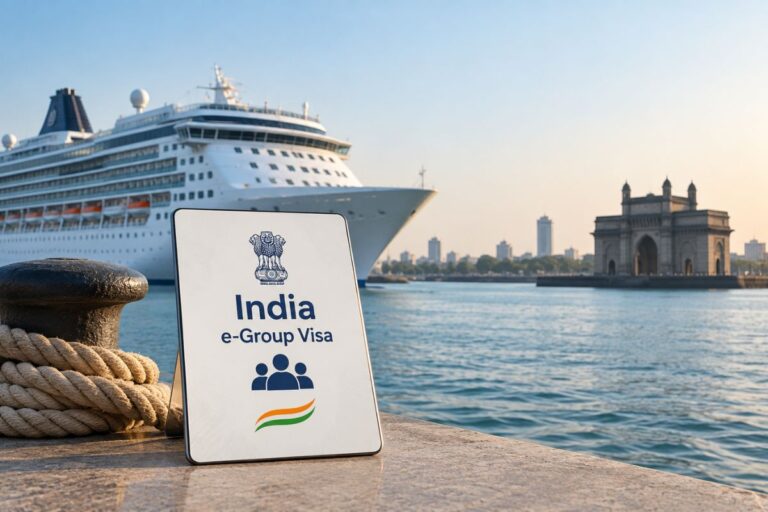 What is e-Group Visa?
The e-Group Visit Visa (Cruise) is a digital visa option for organized groups traveling to India via cruise ship.
Instead of having each passenger submit a separate visa application, the cruise operator or its authorized agent submits the group application online. Once accepted, guests receive a QR-coded visa that may be utilized at immigration checkpoints along the cruise route.
According to the Ministry of Home Affairs' statement on the new service, there is no declared limit on the number of passengers who can be included in a group application.
Who is eligible?
The feature is open to citizens of the 172 countries that are currently qualified for India's e-Tourist Visa. However, eligibility is dependent on the cruise conditions: guests must arrive on a cruise ship following a set and predetermined route.
This is not, therefore, a general group-tour visa for those arriving by air or traveling independently throughout India.
For the cruise operator or authorized agency, the key requirements are:
Submit the group application via the specified Indian visa web or mobile app.
Apply at least three days before the cruise ship arrives at the first Indian port.
Upload passenger information in bulk, including name, nationality, passport number, and issuance and expiration dates.
Ensure that the cruise adheres to the announced set itinerary.
Passengers must travel with an approved QR-coded e-Group Visa.
The Indian e-Visa system also requires a valid passport and supporting documentation, which varies by visa category and nationality. The government recommends travelers to use the official portal rather than brokers that claim to offer expedited visa processing.
The government has yet to publish a separate, specific charge for the new e-Group Visit Visa (Cruise) in the public announcements available thus far.
India's e-Visa fees vary depending on nationality and visa category, and the official portal displays the applicable charge during the application process. Travelers should thus confirm the amount through the official system before making payment, rather than relying on third-party numbers.
The method is designed around the cruise operator, not individual passengers:
The cruise operator or authorized agent collects passenger information.
It uploads the data in bulk via the appropriate Indian e-Visa webpage or mobile app.
The application must be submitted to the authorities three days before the ship's first Indian port visit.
Once granted, the electronic visa includes a QR code.
Passengers produce the QR code at immigration and travel throughout India following the approved cruise schedule.
India already enables e-Visa entrance at 38 specified seaports, and the government has implemented QR-based immigration clearance and modernized cruise terminals in Mumbai, Visakhapatnam, and Chennai.
The pattern is clear: India is attempting to reduce the administrative barriers that cause cruise lines to miss a stop. Passengers gain from less paperwork, while cruise firms benefit from the ease of managing many Indian port calls.
Travunited Take:
We consider the e-Group Visa as a practical victory for cruise passengers, particularly large organized groups, albeit the lack of a disclosed price means that operators should double-check expenses before booking.


