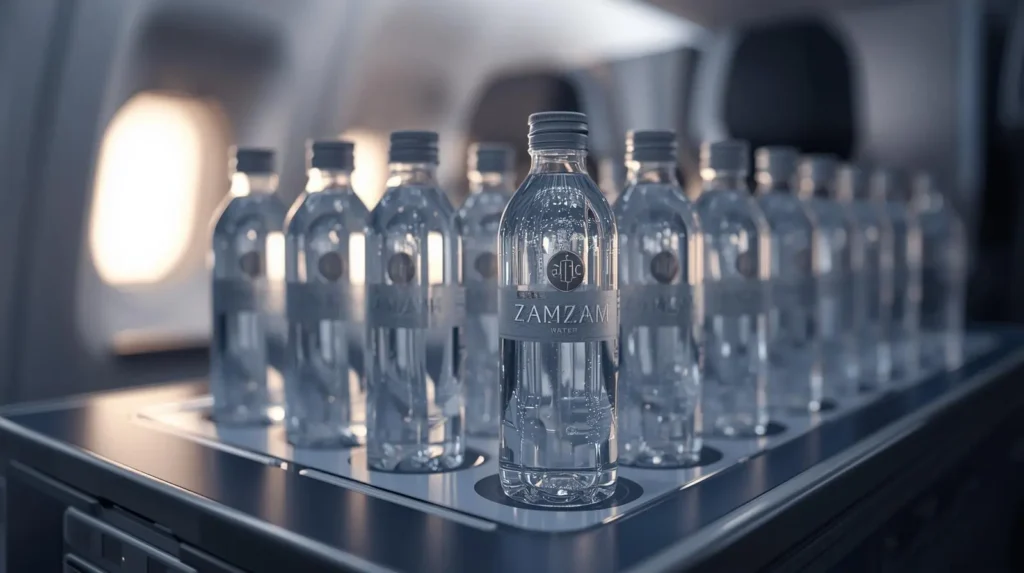
Zamzam Water Airline Regulations 2026: Which Airlines Permit a Free Additional Bag?
Do you intend to return from Saudi Arabia with Zamzam water? This is a brief airline-by-airline reference that covers baggage regulations, packing specifications, and things Indian travelers should know before returning home.
The Umrah schedule for the 1448 AH season has been formally released by Saudi Arabia. According to the news, Saudi Arabia will begin accepting Umrah visas on May 31, 2026, and foreign pilgrims would be able to arrive on June 1.
Bringing Zamzam water for family and friends is just a part of the journey for many pilgrims returning home after Umrah. However, because each airline has its unique regulations regarding Zamzam water, many travelers are still taken off surprise. The amount of baggage you can bring, how you must pack it, and whether it counts toward your baggage allowance are all determined by the airline.Zamzam Water: What Is It?
Every year, following Umrah and the Hajj, millions of pilgrims bring the holy spring water from Makkah, known as Zamzam Water (�مňم). In some situations, airlines handle it like any other liquid, while in others, they treat it as a near-impossibility.
Zamzam Transport's Golden Rules
Every traveler must follow the general guidelines set forth by the Saudi General Authority of Civil Aviation (GACA) before examining particular airlines:
1. Not Self-Filling
The first and most crucial regulation for transporting Zamzam water is that it cannot be packed in your bags straight from Makkah taps. It will be seized by airport security.
2. Only Official Bottling
The official, factory-sealed 5-liter plastic container, enclosed in a cardboard box for protection, must be purchased. These bottles are sold for about 12 SAR at authorized airport distribution kiosks, such as those at King Abdulaziz International Airport Terminal 1.
3. The Cabin Baggage Rule of 100ml
Under international liquid security regulations, airlines severely prohibit Zamzam water in cabin luggage on all international flights. A translucent 1-liter resealable plastic pouch containing a container of 100 milliliters or less is the only exemption.
4. Avoid packing in suitcases.
Finally, never put Zamzam bottles in the main luggage that holds your clothes. This behavior is strictly forbidden by airlines. It needs to be transported as a separate, marked item of freight.
2026 Zamzam Water Regulations by Airline
Nearly all airlines restrict each passenger to one 5-liter bottle of Zamzam. Baggage regulations are what really make the difference. While some airlines count it toward your checked luggage allowance, others offer it as a free extras.
The amount of Zamzam water you can bring, the airlines that permit it, and the guidelines you should be aware of before taking a flight are all listed here.
Air India
Particularly during the Hajj and Umrah seasons, Air India offers direct flights to Jeddah and Madinah from Indian cities like Delhi, Mumbai, Hyderabad, Lucknow, and Kochi. For Indian pilgrims visiting Saudi Arabia, the airline is still one of the most popular choices.
Zamzam Water Regulations:
On Hajj and Umrah charter flights, each passenger is often allowed to carry up to five liters of Zamzam water.
Zamzam needs to be packed in a container that is leak-proof and sealed.
Airport packaging that is factory-sealed is highly recommended.\
Typically, the container counts toward the allotted amount of checked baggage.
Cabin luggage is subject to standard 100ml liquid restrictions.
On regularly scheduled flights, there is typically no specific cabin exemption available.
IndiGo
IndiGo serves Umrah pilgrims from Delhi, Mumbai, Hyderabad, Srinagar, Kochi, and other Indian cities with flights to Jeddah and Madinah. Compared to full-service airlines, baggage enforcement is typically more stringent because it is a low-cost carrier.
Zamzam Water Regulations:
On some Umrah and Hajj flights, up to five liters of Zamzam water are permitted.
Zamzam can only be transported in checked luggage.
To prevent leaks, containers must be properly sealed.
There are no exceptions to the standard cabin liquid rules.
If the weight limit is exceeded, there are additional baggage fees.
At check-in, bottles that are loose or improperly packed are frequently turned away.
Saudia
Saudia continues to be one of the largest carriers for Hajj and Umrah travel, connecting several Indian towns with Jeddah and Madinah. In general, the airline adheres strictly to Saudi aviation regulations, which include handling Zamzam water differently.
Zamzam Water Regulations:
Typically, each passenger is permitted to carry up to five liters of Zamzam water.
It is preferred to use sealed containers provided by the airport.
Saudi Arabia has traditionally permitted Zamzam in cabin luggage as a religious exemption on some itineraries from Jeddah or Madinah.
Cabin exemptions are not guaranteed and are largely dependent on airport security procedures.
During screening, personal containers are more likely to be rejected.
It is advisable to confirm the most recent regulations directly with the airline prior to departure.
The Emirates
Emirates offers flights to Jeddah and Madinah after connecting Indian tourists to Saudi Arabia via its headquarters in Dubai. Because of Emirates' extensive network throughout India, many pilgrims from India use it for one-stop Umrah travel.
Zamzam Water Regulations:
Within the airline's luggage allowance, Zamzam water is permitted in checked baggage.
For cabin baggage, there is no particular exemption.
The international 100ml liquid limits are rigorously adhered to at Dubai Airport.
Before transfer screening, travelers passing through Dubai should safely load Zamzam.
When traveling, carrying loose bottles can cause issues at security checkpoints.
Flydubai & Flynas
Price-conscious pilgrims are frequently drawn to Flynas and Flydubai's affordable Umrah itineraries between Saudi Arabia and India.
Zamzam Water Regulations:
Flynas often allows checked baggage to contain up to five liters of Zamzam water.
Flydubai does not have any cabin exemptions and adheres to typical UAE liquid restrictions.
Both airlines want containers that are adequately sealed.
Depending on the kind of fare, checked luggage may need to be purchased separately.
On low-cost carriers, excess luggage fees can rapidly raise travel expenses.
Oman Air
Oman Air offers connecting flights to Jeddah via Muscat from Indian destinations like Hyderabad, Kochi, and Kozhikode. The airline is well-liked among South Indian Umrah pilgrims seeking affordable tickets.
Zamzam Water Regulations:
In checked baggage, up to five liters of Zamzam water are usually allowed.
If Zamzam is packed outside of the main luggage, it must be declared separately at check-in.
Compared to Saudi airports, Muscat Airport has more stringent liquid screening procedures.
Liquid exemptions for cabin luggage are typically not offered.
Smooth passage still depends on proper sealing and packing that has been certified by the airport.
Crucial Things Travelers Need to Keep in Mind
Purchase Zamzam exclusively from authorized Saudi retailers.
Rejecting loose plastic bottles is common.
Zamzam should not be placed in regular suitcases.
During the peak times for the Hajj and Umrah, get to the airport early.
During the busiest pilgrimage months, regulations may change at any time.
During the Umrah holidays, flights to India from Jeddah and Madinah are extremely crowded. Ground personnel are now far more stringent than they were previously.
FAQs, or frequently asked questions
Can I bring Zamzam water in my cabin luggage?
No. The majority of airlines only permit it in sealed containers as checked luggage.
What is the maximum amount of Zamzam water that a single passenger can carry?One 5-liter container per passenger is permitted by the majority of airlines.
Does the standard baggage allowance include Zamzam water?
Sometimes it's true, sometimes it's not. During the Hajj or Umrah seasons, full-service airlines frequently handle it differently.
Over the years, airlines have quietly tightened Zamzam regulations. Before departing Saudi Arabia, I would highly advise reviewing the most recent policies of your airline, particularly if you are traveling to India on a low-cost carrier.


